Season & Weather
Overview
High summer for beaches and castles, May and June for the orchid bloom, late September for the Skördefest, when Öland is worth a visit, with climate, seasonal prices and opening hours for the attractions.
The best time to visit Öland depends on what you're after. If you want to swim and take in the full programme of castles, forts and the zoo, come in high summer. If you're after orchids and bird migration, travel in spring; for quiet and the Skördefest, come in autumn. The island wears a different face in every season, this overview sets out when each one is worth it, with climate, opening hours and the seasonal prices of the major attractions.
Öland is Sweden's sunniest and driest region, but it warms up late. Average daily highs climb from around 10°C in April through 16°C in May to 20°C in June. The warmest months are July and August, at about 21°C; by September the average drops back to around 17°C.
The sea lags well behind the air. In May the Baltic is still under 10°C, rising to around 13 to 14°C in June. It only becomes swimmable in July (16 to 17°C) and August (17 to 18°C, the warmest month for swimming), the water only tops 20°C briefly on hot days at the shallow beaches. In September the sea holds on to its warmth for a while as the air already cools. For a full breakdown of sunshine hours, rainfall and the ever-present wind, see the guide Weather & Climate on Öland.
High summer is peak season, warm weather, a swimmable sea and every attraction running at full capacity. In practice that means:
The price of all this is crowds. There are no hard occupancy figures, but qualitatively: it's busier, and accommodation is in demand, so book early.
The major sites stagger admission and opening hours by season, one more reason to choose your travel dates deliberately. Adult prices for 2026 at a glance:
| Attraction | Shoulder season | Main season | Late season |
|---|---|---|---|
| Eketorp fortress | 75 SEK (1 May and 1-18 June, Wed-Sun 11:00-15:00) | 150 SEK (20 June-16 August, daily 10:00-17:00) | 125 SEK (19-30 August, Wed-Sun 11:00-16:00) |
| Solliden Palace Park | 150 SEK (7 May-14 June, 10:00-17:00) | 150 SEK (15 June-30 August, 11:00-18:00) | 150 SEK (31 August-27 September, 11:00-16:00) |
| Ölands Djur- och Nöjespark | 195 SEK, zoo only (May-12 June) | 495 SEK, all-inclusive (13 June-16 August) | 195 SEK, zoo only (17-30 August) |
| Borgholm Castle | 140 SEK (28 March-21 June) | 150 SEK (22 June-8 August) | 140 SEK (9 August-1 November) |
Two notes on the table: at Solliden the price stays the same across all three phases, only the opening hours are staggered. Borgholm Castle stays closed on 13 and 14 July (set-up for the Victoria concert) and on 24 September, and accepts card payment only. The Eketorp fortress grounds themselves are free to enter year-round outside the buildings, you only pay for access to the exhibition and the fortress interior during the season.
Midsummer, Sweden's most important summer festival, deserves its own section. In 2026, Midsummer's Eve falls on Friday 19 June, with Midsummer Day on Saturday 20 June, the latter is a public holiday. The date shifts each year; Midsummer Day always falls on the Saturday between 20 and 26 June.
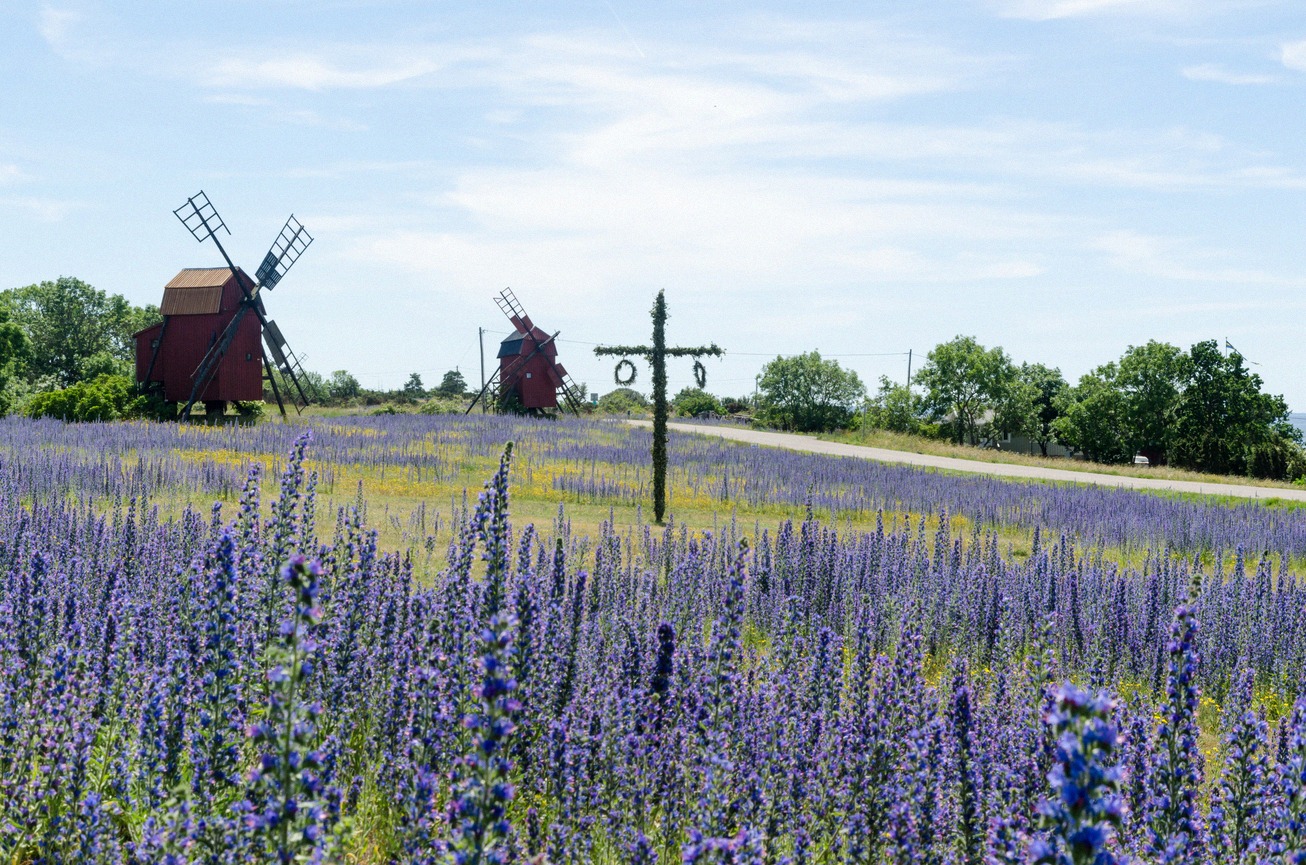
Celebrations are centred on Midsummer's Eve, with dancing around the decorated maypole, herring, new potatoes and strawberries, on Öland spread across more than 20 locations, mostly at the island's heritage farms. The island gets correspondingly busy that weekend, so accommodation and travel need planning ahead of time. Two details worth knowing: Eketorp fortress stays closed on Midsummer's Eve and opens only from 10:00 to 14:00 on 22 June, and Solliden Palace Park is open only from 11:00 to 14:00 on 19 June. All of the year's festivals, from Midsummer through Victoria Day on 14 July to the concert season in the Borgholm castle ruins, are collected in the guide Events & Festivals on Öland.
Spring is the season for nature lovers, and for free experiences, since Öland's great natural sights are all open access. On Stora Alvaret, one of the world's largest alvar landscapes at around 26,000 hectares and a UNESCO World Heritage Site, the mass bloom begins in May with Adam och Eva (early marsh orchid) and Sankt Pers nycklar (green-winged orchid). June is the biggest orchid month, when lady's slipper, Jungfru Marie nycklar, Krutbrännare, Ängsnycklar, Johannesnycklar and the fly orchid are among those in flower. Skogsbyalvaret, part of Stora Alvaret, is an easily accessible area to look for them.
Bird migration runs in parallel. More than 400 bird species have been recorded at the southern tip around Ottenby; spring migration peaks in April and May, with May the most species-rich month of the year on Öland. Large numbers of birds of prey also pass through in the second half of May. The nature reserve and its Naturum exhibition are free; only the Långe Jan lighthouse charges 50 SEK (children 30 SEK).
The seasonal attractions are still ramping up at this point: Solliden opens on 7 May (daily 10:00 to 17:00), Eketorp fortress only receives visitors on 1 May in May itself, then runs Wednesday to Sunday from 1 to 18 June at the shoulder-season price of 75 SEK. The zoo runs a low-season schedule until 12 June - 195 SEK, with only the zoo itself open (11:00 to 17:00). The upshot: noticeably quieter and cheaper than high summer, but the sea is still too cold for swimming.
September is often still mild and pleasantly uncrowded. Its highlight is the Ölands Skördefest (harvest festival), one of the largest in Sweden: 24 to 27 September 2026 (opening on the evening of 23 September), with more than 900 events from the southern to the northern tip of the island. There's no flat entry fee, and many events are free and need no booking, the details are in the festival calendar.
The autumn bird migration is another draw: weeks 41 and 42 (mid-October) are considered the peak of autumn birdwatching, when rarities from the east turn up. In mid-October, thousands of barnacle geese migrate along the east coast, birds of prey pass through in the first half of October, and wood pigeons continue into November.
After that, the season winds down. Solliden runs its final phase from 31 August to 27 September (11:00 to 16:00), Eketorp fortress closes after the late season on 30 August (an autumn-half-term opening for 2026 had not yet been published as of early June), and the Borgholm castle ruins stay open until 1 November before shutting for the winter months. The Eketorp fortress grounds remain freely accessible outside the season, but without staff, the exhibition or activities.
From November to March it's low season, with markedly fewer visitors. Öland doesn't shut down: restaurants, accommodation and shops stay open, especially in the larger towns of Färjestaden, Borgholm, Mörbylånga and Löttorp, and in Borgholm shops, cafés and restaurants operate year-round. Many seasonal attractions do pause, though. Travellers after stillness, wide open space and empty coastline find a different, very appealing side of Öland, those after a full programme, less so.
As a rule of thumb for deciding when to go:
For what the weather in each of these windows actually looks like, from the 2,100 hours of annual sunshine to the ever-present wind, see the guide Weather & Climate on Öland; festival dates are collected in the overview Events & Festivals.