
Getting There & Around
Overview
All the ways to reach Öland at a glance, the toll-free Öland Bridge from Kalmar, summer ferries to Byxelkrok and Färjestaden, flights to Kalmar Öland Airport, plus trains, buses and driving in from continental Europe.
Öland is refreshingly easy to reach, almost every route funnels through the mainland city of Kalmar. From there, the toll-free Öland Bridge spans the Kalmarsund, the strait between the mainland and the island, and this is where road, air and rail travel all converge. In summer two ferries add extra options, a car ferry in the north, and a cycle ferry across the strait itself, alongside a through train-and-bus connection for anyone arriving without a car.
Exactly three crossings link the mainland to Öland over the strait, there's no fourth. There's no direct ferry from Copenhagen or the south Swedish coast straight to Öland, and flights and trains both terminate in Kalmar, from where the bridge carries you the rest of the way.
| Crossing | Who it's for | Duration | Price | 2026 season |
|---|---|---|---|---|
| Öland Bridge Kalmar-Färjestaden | Cars, motorbikes, coaches | approx. 10-15 min from Kalmar city centre | toll-free | year-round |
| Car ferry Oskarshamn-Byxelkrok | Cars, motorhomes, motorbikes, foot passengers | approx. 1 hr 55 min | Car with up to 5 people 625 SEK one way | 12 June - 30 August |
| Cycle ferry Kalmar-Färjestaden (M/S Dessi) | Foot passengers and cyclists only | approx. 30 min | Adults 80 SEK one way, bikes free | 15 June - 16 August |
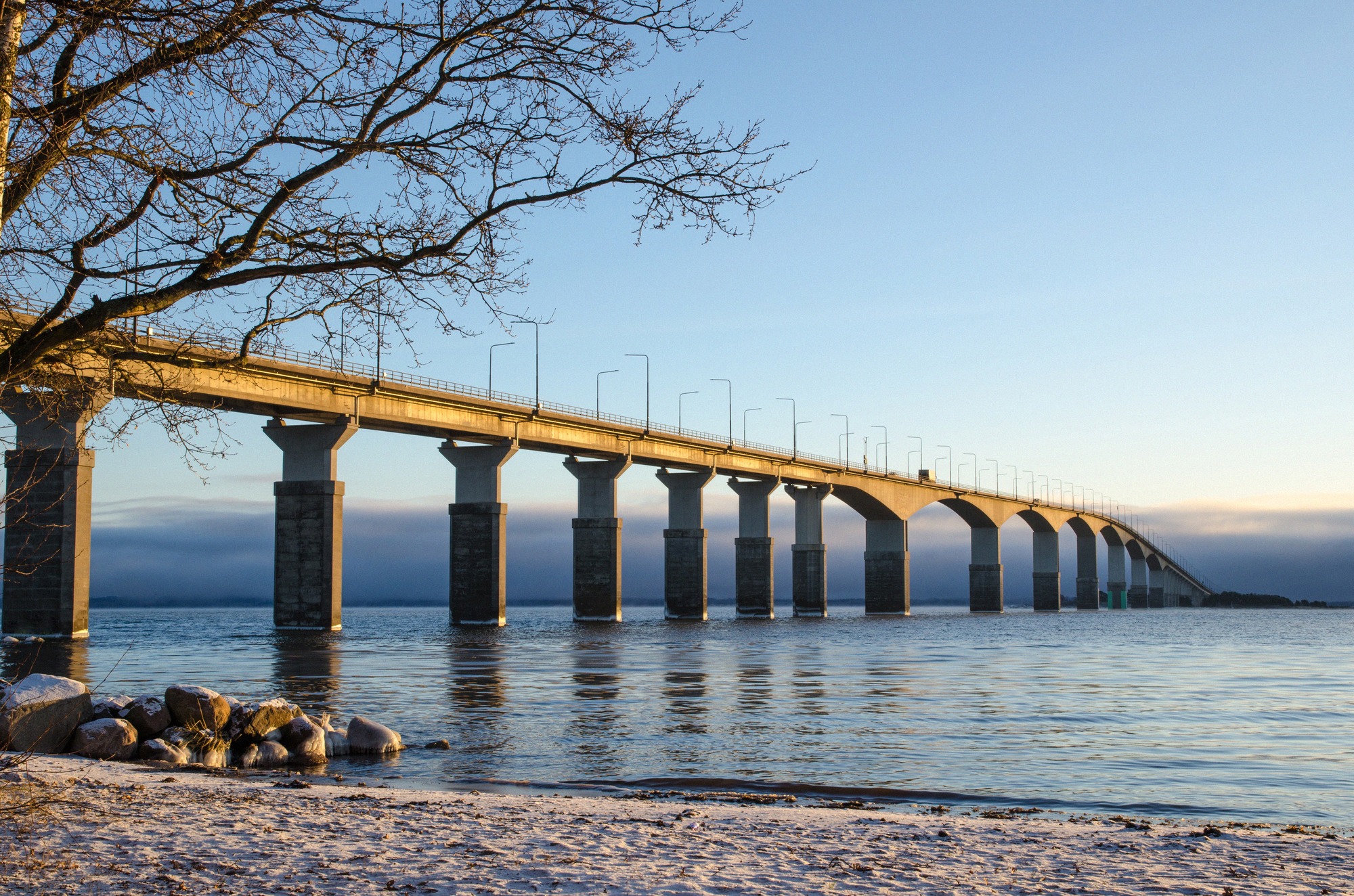
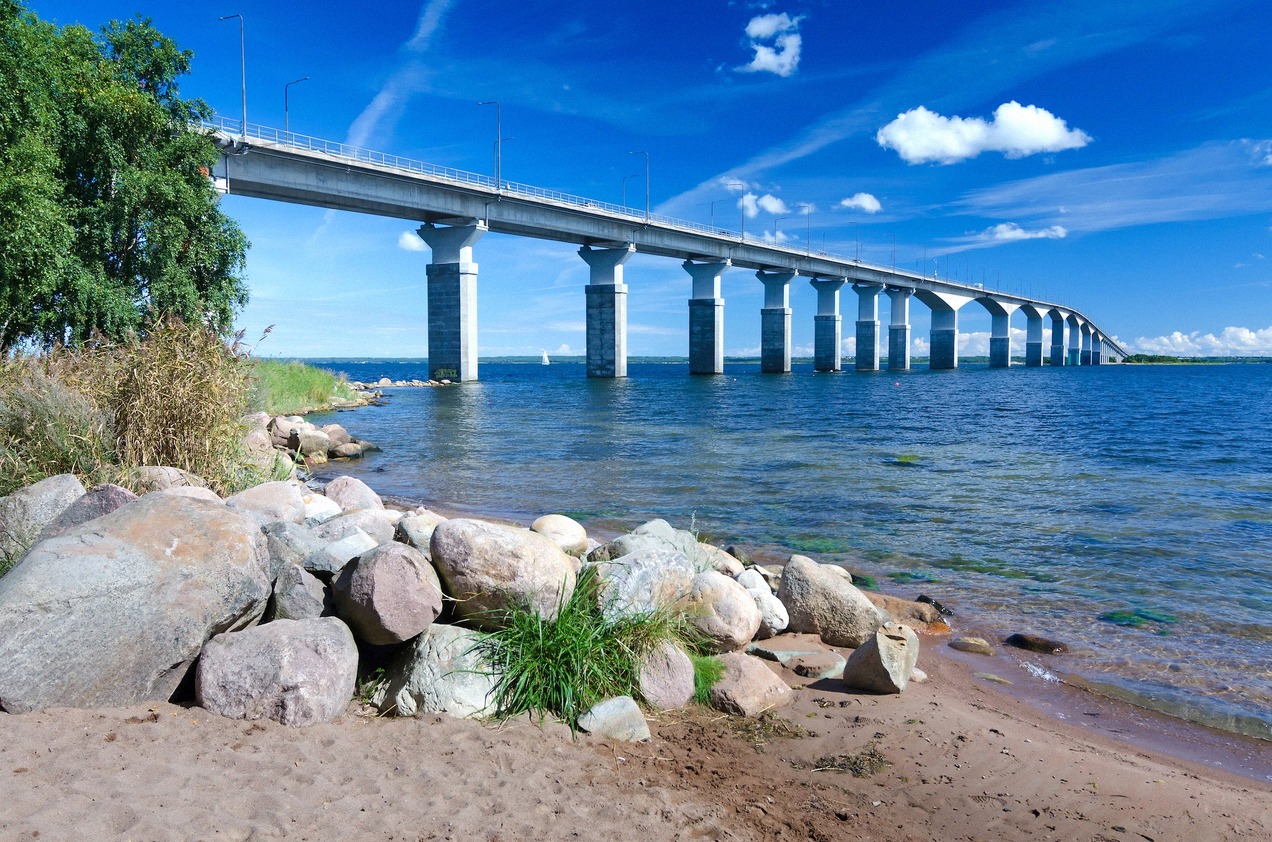
The classic route onto the island is the Öland Bridge (Ölandsbron) - 6,072 metres across the Kalmarsund between Kalmar and Färjestaden, opened in 1972, toll-free and open year-round. From Kalmar city centre to Färjestaden takes around 10 to 15 minutes depending on traffic, longer in summer. According to Trafikverket, around 25,000 vehicles a day cross the bridge in summer, about 15,000 the rest of the year, with peaks of up to 36,000 during the autumn harvest festival (Skördefest).
One thing worth building into your plans, the bridge is wind-sensitive. In severe storms Trafikverket closes it in stages, first to wind-sensitive vehicles such as lorries, trailers and caravans from around 27 m/s, then completely from around 32 m/s (hurricane force). If you're travelling with a trailer or motorhome, keep an eye on the forecast. Cyclists and pedestrians have been banned from the bridge itself since 2009. Full details on the crossing are in the guide The Öland Bridge.
In high summer there's an appealing alternative to the bridge, the car ferry Oskarshamn-Byxelkrok on the island's north coast. In 2026 it runs from 12 June to 30 August, and the crossing takes around 1 hour 55 minutes, a proper short sea voyage. The appeal is in the route it opens up, arrive in the north and you can drive the length of the island south to north (or vice versa) and take the bridge back, without retracing your steps. The one-way fare is 625 SEK for a car with up to five people, 150 SEK for an adult without a vehicle, 320 SEK for a motorbike, and from 1,000 SEK for a motorhome. Booking via olandslinjen.se is recommended, and the crossing is weather-dependent.
For cyclists and foot passengers, the cycle ferry M/S Dessi runs between Kalmar (Tullhamnen) and Färjestaden (Södra hamnplan), in 2026 from 15 June to 16 August, crossing time around 30 minutes, with room for 50 bikes carried free of charge. Adults pay 80 SEK one way or 134 SEK return, and children under 13 travel free when accompanied. Since 2026 the local municipalities have run the service rather than Trafikverket, the 2026 season is secured, awarded to Ressel Rederi, with future years still open. Both crossings are covered in the guide Ferries to Öland.
If you're travelling on limited time, fly into Kalmar Öland Airport (KLR), a few kilometres west of the city centre. The only scheduled route runs via Stockholm/Arlanda with SAS, year-round, around nine flights a week, roughly an hour's flying time. Car hire is available right at the terminal, and since the bridge starts on Kalmar's eastern edge, you can be on the island within about 15 to 20 minutes of landing. Heading into town instead, bus 402 runs to Kalmar C. More detail in the guide Flying to Öland.
Without a car, the journey runs via Kalmar C railway station. The Öresundståg service from Copenhagen takes around 3 hours 45 minutes, with SJ services from Gothenburg as an alternative. The final leg is covered by Kalmar Länstrafik (KLT) buses, on the island, line 101 (Kalmar-Borgholm-Löttorp/Böda) and line 102 (Färjestaden-Borgholm) carry most of the traffic across the bridge.
Travelling by car from continental Europe, the usual route runs via Denmark, the ferries Puttgarden-Rødby (around 45 minutes) or Rostock-Gedser (about 1 hour 45 minutes), followed by the Öresund Bridge into Sweden; combination tickets covering both the crossing and the Öresund Bridge are available. The alternative that skips Denmark altogether is the direct ferry Rostock-Trelleborg (TT-Line/Stena Line, around six to seven hours), with the E22 continuing on to Kalmar from Trelleborg.
Realistically, there's still a fair stretch of Swedish mainland driving ahead once you're off the ferry at Rødby or over the Öresund Bridge, so an overnight stop en route is worth building in. As a rule of thumb for choosing how to travel - flying plus a hire car tends to suit one or two people short on time, while driving plus ferry suits families with plenty of luggage who want their own car once on the island; the trade-offs are covered in more detail in the guide Flying to Öland.
The high season is summer, and Öland is known as one of the sunniest regions in Sweden, so July and August get busy. Peak congestion at the bridge concentrates on summer weekends, typically the Friday midday arrival rush and the Sunday evening departure rush. If your schedule is flexible, travel early in the day or midweek instead. And if you're relying on the ferries, keep the seasonal windows in mind, both the car ferry and the cycle ferry run only in high summer, while in winter the bridge is the sole route, with its occasional wind closures.