Medieval Churches of Öland
Fortified churches, ruins and rune stones - Öland's 34 medieval churches tell of prosperity and a need for protection on a contested Baltic frontier.
Contents
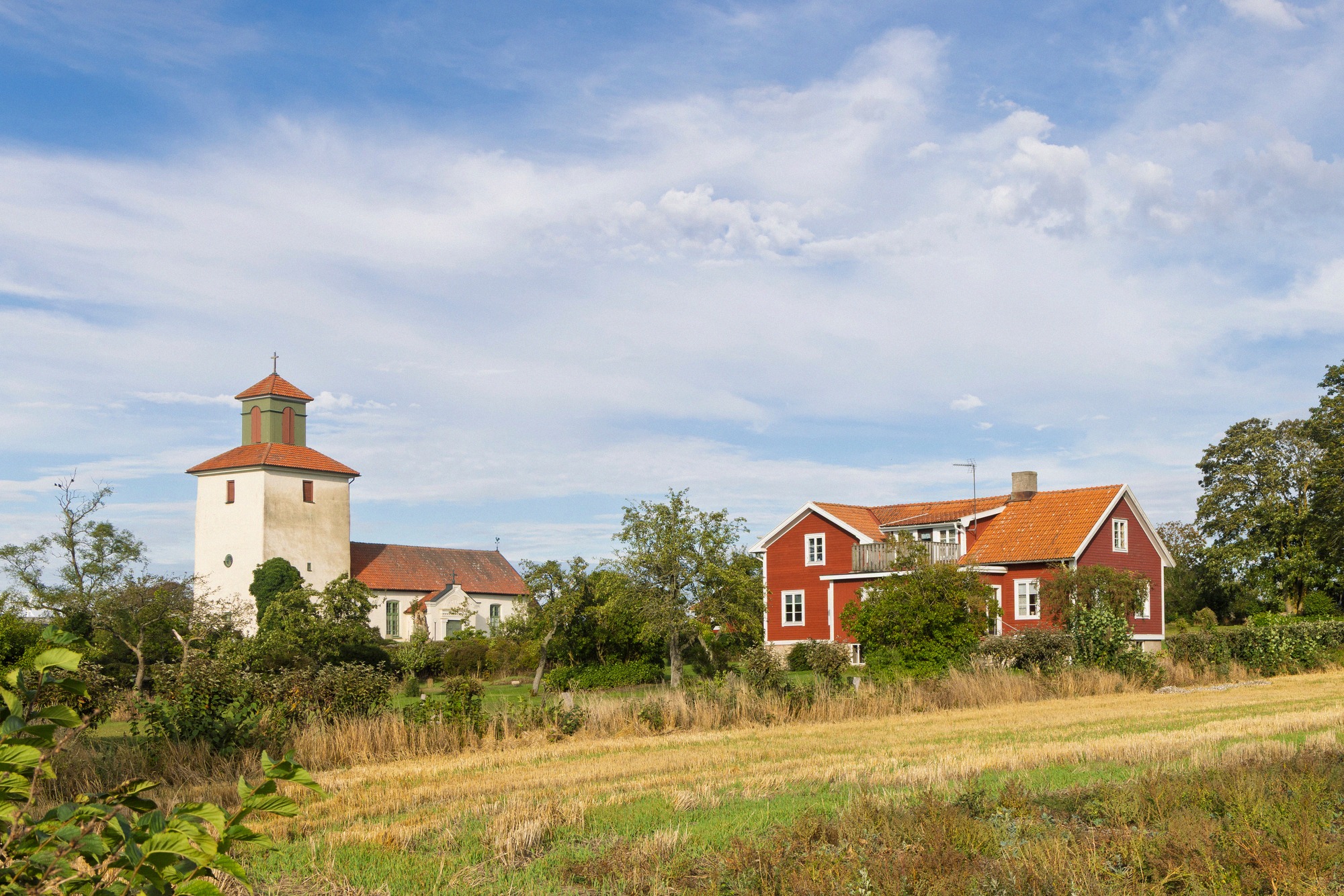
Old stone churches are scattered across the whole island, most with medieval origins. Alongside the windmills and castles, they are among Öland's most striking landmarks, and they tell their own story: of economic prosperity, an exposed position on a contested sea border, and a need for protection that gave some churches an outright defensive character. This guide sets out what's known and highlights the churches worth a detour.
34 medieval churches
Öland has 34 medieval churches recorded, along with eight chapels. Practically every parish church (sockenkyrka) was already a stone church in the Middle Ages, built from the limestone found across the island. In the early 13th century, almost all the churches were extended in Gothic style and given a tower.
A distinctive feature of Öland is the klövsadelkyrkor, or "saddle churches", which shaped almost half of the island's churches: each had a tower at both ends of the nave. Over the centuries many of these towers have disappeared, but the building type remains one of the island's architectural specialities.
Not everything from the medieval interiors has survived. Medieval limewash paintings can still be seen in only a handful of churches - namely Resmo, Gärdslösa, Glömminge, Hulterstad and Ventlinge. Anyone keen on the original imagery should head to these specifically.
Fortified churches of a frontier region
The fact that many of Öland's churches look massive and fortress-like has a documented reason. In the 12th and early 13th centuries, stone churches with a clear defensive character were built in every parish, evidence of economic prosperity paired with a tangible need for protection. The island lay exposed on the Baltic, and Wendish Vikings raided it. In turbulent times, the church offered not just spiritual but very practical shelter.
Politically, Öland came under the diocese of Linköping during this period. A papal bull issued by Alexander III in 1177 required the island's parishes to be visited every three years. Royal Swedish power controlled Köping and Borgholm, where a kastal (fortified tower) was built towards the end of the 12th century, the forerunner of the later Borgholm Castle ruin. Danes and Swedes were frequently in conflict during these centuries, which further explains the fortified style of building.
Källa gamla kyrka, the clearest example
The clearest surviving example of a fortified church is Källa gamla kyrka in the north-east, also known as Källa ödekyrka ("abandoned church"). It originally had two additional storeys above the nave: below, the worship space; above that, a store for provisions; and at the very top, arrow slits for defence. There is scarcely a better illustration of an Öland church's dual function.
The stone building was begun around 1170 and extended in stages until the mid-13th century; a wooden church had already stood on the same site in the 11th century. The old church was abandoned in 1880, when the new Källa church was built. It then fell into disrepair, but a planned demolition was blocked by the Vitterhetsakademien (Royal Academy of Letters), today the roof still stands, though the interior is not fully preserved.
Since 2015 the site has been managed by Statens fastighetsverk, with Borgholms slott as tenant. In summer, Källa is open to visitors and used for weddings, christenings and concerts. The church stands on the road to Källahamn harbour, at roughly 57.11 N / 16.99 E.
Gärdslösa and Resmo, the best-preserved churches
Gärdslösa kyrka in the east of the island is considered Öland's best-preserved medieval church. The western part of the nave and the tower date from the 12th century, with the transept extensions added in the 13th century. The Gothic stepped gable on the chancel, from the late 13th century, is considered unique on Öland. The cross-vault was created around 1240 by a master builder known as the "Gärdslösa Master", while the limewash paintings date from 1498 (Magnus Ingelsson) and 1642 (Peter Bundi). Gärdslösa remains an active parish church and is a very popular destination in summer. It stands at roughly 56.79 N / 16.74 E.
Older still is Resmo kyrka in the south-west: it is the oldest surviving, still-used church building of medieval Sweden. It was built as a klövsadelkyrka, with a tower at each gable. Resmo holds Öland's largest set of Romanesque paintings, the earliest from the early 12th century, the only church on the island with Romanesque paintings from two separate periods. Anyone interested in Öland's earliest church art should not miss Resmo.
Also worth seeing is Hulterstads kyrka further south: the foundations of a 12th-century stone church lie beneath the floor of the western section, and inside are 15th-century limewash paintings as well as rune stones.
Rune stones at and in the churches
Many of Öland's churches stand on very old ground, and some contain rune stones, often built into the walls, set up in the porch, or scattered around the churchyard. The most rewarding place to see them is Köpings kyrka in Köpingsvik: in the porch, a small rune stone museum displays a selection from around 75 rune stone fragments found in and around the church - 24 fragments and one complete stone are on show. The stones date from the late 11th and early 12th centuries and were once broken up and built into the church walls. South of the church also stands "Tings flisa", a rune stone roughly three metres tall.
Runstens kyrka holds a linguistic curiosity: in its sacristy stands the stone Öl 31, and the Bjärby stone from the same parish carries the only occurrence of the word "kyrka" (church) on any rune stone in Sweden - broadly meaning that someone was buried at the church. Runes also survive at Gärdslösa (a rune stone fragment in the porch) and at Resmo (whose stone is now held at the Statens Historiska Museum in Stockholm).
Öland's most famous rune stone, however, is not at a church: Karlevistenen, near Karlevi on the west coast, about ten kilometres south of the Öland Bridge (Ölandsbron), stands in a field close to the Kalmar Strait (Kalmarsund). The 130-centimetre stone, dating from the late 10th century, is the oldest on the island and bears the only completely preserved skaldic stanza in dróttkvætt metre found on any rune stone. It was raised for a chieftain and mentions "Denmark", a fitting historical starting point for any rune-stone tour.
Planning a visit, season, hours, and a shortlist
Most of Öland's churches open in summer as Vägkyrkor ("road churches" or summer churches), usually from Midsummer until the start of the Swedish school year. In 2026 this season runs roughly from mid-June to mid-August, and the churches are generally accessible between about 10:00 and 16:00. Vägkyrkor typically offer a daily service, simple refreshments and a toilet. Admission is usually free.
Exact opening hours are reported afresh each year by every parish to the diocese, so the precise 2026 times are only confirmed shortly before the season starts. If you're looking for open churches and their current hours, the best resource is Kyrkguiden, the directory recommended by the Church of Sweden. Outside the summer season, many medieval churches can often only be viewed from the outside.
For a shortlist that fits into one to two days, Gärdslösa, Källa, Resmo and Köping make a good combination, covering a fortified church, the best-preserved building, the oldest paintings and rune stones. Allow around 30 to 60 minutes per church. Most churches sit conveniently close to the main roads and combine well with other stops. For guidance on when the island is at its best overall, see Best Time to Visit Öland; for an overview of the other highlights, see Öland Attractions, and the island's architectural counterpart is its roughly 350 windmills.