The Windmills of Öland
Öland was once the island of windmills, why around 2,000 once stood here, where the finest rows survive today, and what makes a post mill.
Contents
Few images say "Öland" quite like a windmill against a wide sky. In the 19th century the flat island was more densely covered with mills than almost any other landscape, around 1850 some 2,000 of them were turning. Today about 350 survive, and they still shape the look of Öland just as much as its castles, lighthouses and churches.
Why Öland became the island of mills
The reason is geological as much as practical. Öland has no major rivers or streams that could have powered watermills. For processing grain, the island had to rely on wind power instead, and its flat, largely treeless, windswept landscape supplied it reliably. Where the mainland dammed water to mill, Öland put the wind to work.
The decisive push for large-scale mill building came from a royal decree of 1746, which eased the strict restrictions on timber use. Only then could many farms afford the timber for a mill of their own. A report from 1765 recorded that almost every wealthy farmer built his own mill, more than a tool, it was also a status symbol. A mill on the farm showed you had made something of yourself.
From the 1850 peak to the decline around 1900
The numbers can be traced with surprising precision. By the end of the 17th century, Öland had 375 windmills and 188 watermills. The sharpest growth began from the mid-18th century, a direct result of the 1746 decree. By 1808 the number of windmills had risen to 1,677, and around 1850 the island reached its peak with roughly 2,000 mills.
The sharp decline began around 1900. The small post mills were pushed out by technically superior alternatives: first large smock mills, then steam-powered mills, and finally oil-powered mills that could grind larger quantities independent of the wind. The farm mill had had its day. That so many still stand today owes less to their original purpose than to a later, deliberate effort to preserve them as landmarks.
Post mill and smock mill, the two designs
The typical Öland mill is the post mill, in Swedish stubbkvarn, mostly dating from the late 18th or early 19th century. Its defining feature: the entire mill house turns around a fixed central post to bring the sails into the wind. That makes it compact and unmistakable, the small, rotating wooden boxes on a post are the sight you find everywhere on Öland, in the villages and along the main road.
- Post mill (stubbkvarn), the whole house turns around a post; by far the most common design and the island's landmark.
- Smock mill, only the cap with the sails turns, while the tower stays fixed; larger and more powerful. Around 1900 there were about 30 on Öland, and today around ten survive.
Almost everywhere, the main task was grinding grain into flour. There were also specialised forms: at Jordhamn stood a mill that used wind power not to grind wheat but to grind limestone, a stone-grinding mill that shows how naturally islanders put the wind to work for all kinds of tasks.
Lerkaka, the best-known row of mills
If you see only one row of mills on Öland, make it Lerkaka, in the parish of Runsten on the island's east side, in Borgholm municipality. South of the village stands one of the island's most visited mill rows: five post mills under hipped roofs, lined up right along the roadside. There is parking at both ends of the row, with a separate area for coaches and motorhomes, and a former smithy has been converted into a café.
The local society has opened up one of the five mills, so visitors can see how a post mill works from the inside. Information boards explain the mechanism; allow around 20 to 30 minutes for a visit. The mill opens seasonally in summer, no official 2026 hours are confirmed yet, but viewing the row from outside is free at any time.
Right opposite the mills, a second sight is worth a look: a Viking-age rune stone (Ölands runinskrifter 37), around 215 centimetres tall and carved with a double dragon loop. Mills and rune stone together make Lerkaka a rewarding short stop. Full practical details are on the Lerkaka Windmills page.
Sandviks kvarn, the largest windmill in northern Europe
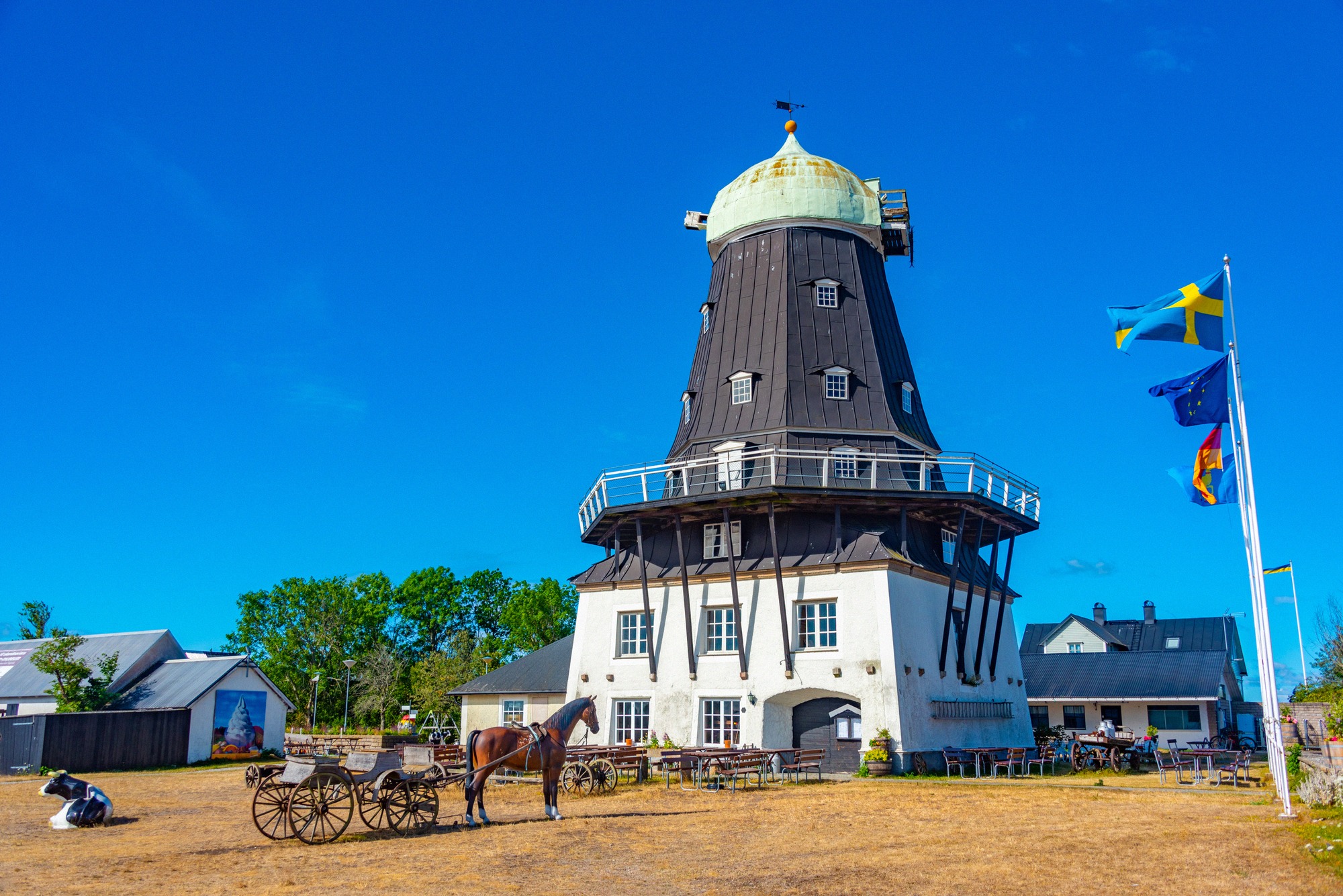
A different scale altogether is Sandviks kvarn in the village of Sandvik on the west coast of northern Öland, around 30 kilometres north of Borgholm. It is considered the largest windmill in northern Europe: an eight-storey smock mill, 26 metres tall, with a sail span of 24 metres.
It was not built on Öland but near Vimmerby in Småland in 1856, and only moved to Sandvik in 1885. Today it is fully preserved and, in summer, open as a museum via narrow internal staircases, with a restaurant and café on the ground floor. The address is Stenhuggarvägen 3 in Sandvik. If you want to do more than admire a mill from outside and actually climb one, this is the place, check the confirmed 2026 opening hours in advance, as only the summer season is guaranteed.
Many more mills open to visitors are scattered across the island, including in Grönhögen and Jordhamn. Incidentally, the parish with the most mills was not Lerkaka but Vickleby, with 77 mills of its own.
Seeing and photographing the mills
You don't need a fixed plan to see mills, they stand in villages and along the main road right across the island. If you do want to plan a route, combine the five mills at Lerkaka in the east with the giant Sandviks kvarn in the north, taking in individual village mills along the way. The open landscape turns every freestanding mill into a photo subject; the low morning and evening light sets off the wooden structures well, though this is not an official recommendation.
To place the mills in the island's wider history, you'll find more figures and background under Öland facts and figures; for an overview of the island's other highlights, see Attractions on Öland, and for the landscape the mills stand in, the guide to Öland's nature is a good match.